

AO Projects —> 005 — Definitions and Scaffolding
This is a Chat with "Chat GPT"
005 - AoP Definitions and Scaffolding
Created: 16/9/2026 10:38:22
Link: https://chatgpt.com/c/6aaa2446-0d90-83ee-a588-9b86149f01a2
9/16/2026, 10:39:39 AM
From my website https://imran.joyfulearth.org/ can you scan the with ai section, mostly 2026 and tell, with sources what a action oriented project is?
9/16/2026, 10:39:40 AM
Yes. I scanned your “With AI” material, with particular attention to 2026, and the idea becomes quite clear once the scattered discussions are put together.
What an Action-Oriented Project actually is
In your 2026 material, an Action-Oriented Project (AoP) is essentially a project disguised as an event, rather than an event disguised as a project.
The key distinction is:
A workshop asks people to participate in an experience. An AoP asks people to contribute to an ongoing body of work.
The gathering-physical, virtual, or hybrid-is only the acceleration point in a much longer cycle.
Your clearest description appears in the June 19, 2026 AI conversation: the AoP is an event where the participants have already been exposed to the work, thinking, discussions and tasks beforehand; they arrive prepared to review, brainstorm, decide and act rather than simply listen. (Joyful Earth)
The basic model
I would express your concept as:
Mission → public preparation → individual contributions → collective acceleration → concrete outputs → continuing work → new projects
Rather than:
Speaker → audience → applause → everyone goes home
That is the fundamental idea.
1. It starts before the event
This is probably the most important feature of your AoP.
The project is announced, but the announcement is not the project.
The people involved-the “pillars” and potential “players”-can see the work that is already happening. Your June material specifically describes making the pillars' body of work available, including their daily work and AI brainstorming/chat logs. (Joyful Earth)
So someone interested in the project can progressively become informed:
Read → think → respond → contribute → collaborate
They don't have to wait until the conference/workshop date.
This also fits very strongly with how you describe your own use of AI: you speak with Gemini extensively, refine ideas, and publish the conversations rather than treating the AI work as a private black box. Your homepage explicitly describes this practice. (Joyful Earth)
2. Everyone can become a contributor
An AoP isn't built around a rigid distinction between:
- expert
- speaker
- attendee
- audience
Instead, somebody can arrive as a player and gradually become a pillar.
That's an important part of the philosophy.
You wrote that every attendee/player is free to put their own thoughts into the public domain and can “slowly gear up to becoming pillars in their own right.” (Joyful Earth)
So the AoP is also an onboarding mechanism for future leadership.
Someone doesn't have to be appointed a leader first. They demonstrate useful work, take responsibility, collaborate, and eventually have enough understanding to lead their own project.
3. The planning happens asynchronously
This is another major difference from an ordinary conference.
Your June model proposes structured email as one of the coordination mechanisms, with experienced people converting incoming contributions into a visible weekly digest and task list. Groups can form around tasks and work together before the physical/virtual gathering. (Joyful Earth)
So you have something like:
PUBLIC PROJECT MATERIAL
        ↓
People study it
        ↓
People respond / contribute
        ↓
Structured email
        ↓
Senior/editorial triage
        ↓
Weekly digest
        ↓
Tasks / groups
        ↓
LIVE AoP GATHERING
The event therefore isn't where thinking starts.
It is where distributed thinking gets compressed into coordinated action.
4. The actual event is a midway acceleration point
This is perhaps the best single definition I found in your material.
You describe the actual gathering as a “midway project acceleration get together.” Its purpose is primarily:
- review
- brainstorming
- resolving questions
- making decisions
- taking collective action
And if the gathering is surrounded by virtual preparation/follow-up, you envisage the project moving extremely quickly. (Joyful Earth)
So instead of:
Day 1 → lectures
Day 2 → workshops
Day 3 → closing ceremony
you have:
Weeks of preparation → acceleration meeting → weeks/months of execution
The meeting is almost like the sprint-planning/acceleration chamber inside a larger project.
5. The outputs matter more than attendance
This is where the word “action” becomes meaningful.
An AoP should leave behind things that did not exist before it:
- research
- documents
- prototypes
- decisions
- tasks
- collaborations
- public resources
- campaigns
- completed work
- new projects
Your June discussion repeatedly comes back to tracking people's work and making the resulting body of work visible. (Joyful Earth)
That means the fundamental question isn't:
“How many people attended?”
It is closer to:
“What moved because these people came together?”
That's a very different event metric.
6. The project continues after the event
This is crucial.
The AoP doesn't end with:
“Thank you for attending.”
The work continues.
And this is where your broader DAWN / Internet of Missions concept comes in. Your homepage describes Action-Oriented Projects as the culmination of accelerated social causes, within the larger idea of an Internet of Missions. (Joyful Earth)
The project becomes a persistent public record of:
what we are trying to accomplish → what people are doing → what has happened → what remains → who is taking responsibility.
7. It is deliberately different from a workshop
I think this distinction is worth making explicit.
| Conventional event | Action-Oriented Project |
| Attendee comes to event | Participant enters an ongoing project |
| Content delivered at event | Content/work exists beforehand |
| Speaker → audience | Pillars ↔ players |
| Participation often ends at event | Participation continues |
| Workshop exercises | Real project tasks |
| Discussion | Review + decisions + action |
| Attendance is important | Contribution is important |
| Event is the product | Project is the product |
| Participants consume | Participants produce |
| Follow-up is optional | Follow-up is intrinsic |
Your June AI discussion explicitly frames the AoP against the one-way/panel-discussion model and against workshops where the activity can remain bounded within the event. (Joyful Earth)
8. AI has a special role in the AoP
This is another thing that becomes apparent from scanning the 2026 archive.
AI isn't necessarily the project.
It is more like the thinking accelerator and publishing companion.
Your proposed first step for launching a mission is:
articulate the vision using AI to have detailed brainstorming/idea-showcasing conversations and publish them as part of the digital footprint. (Joyful Earth)
That creates an interesting loop:
Human has an idea → AI interrogates it → human refines it → conversation becomes public → others respond → project emerges → people act.
And because the conversation itself can be published, somebody encountering the project later can see how the thinking evolved, rather than only seeing the polished final answer.
That is very consistent with the architecture you describe on your homepage: your “With AI” material is effectively part of your working/public record. (Joyful Earth)
9. The AoP is also a replication mechanism
This may actually be the most ambitious part of the idea.
The purpose isn't simply to complete Project A.
It is to teach people how to create Project B.
Your June discussion explicitly puts “Replication via action oriented projects” as the fifth step after vision, engagement, operations and funding. (Joyful Earth)
So imagine:
                         ORIGINAL MISSION
                               │
                               ▼
                         ACTION-ORIENTED
                            PROJECT
                               │
             ┌─────────────────┼─────────────────┐
             ▼                 ▼                 ▼
          Player A          Player B          Player C
             │                 │                 │
             ▼                 ▼                 ▼
        takes ownership   takes ownership   takes ownership
             │                 │                 │
             ▼                 ▼                 ▼
          new project       new project       new project
The successful participant isn't supposed to remain permanently an attendee.
They learn enough DNA to initiate another mission.
That is why the AoP is connected to your larger DAWN idea rather than being merely a better conference format.
10. And the website becomes part of the project itself
This is particularly interesting in your case.
Your homepage says that you want people to own their content and operate relatively simple, file-based web ecosystems rather than becoming dependent on platforms and developers. (Joyful Earth)
The AoP therefore has a natural digital form:
The website isn't merely advertising the event.
It becomes the project's public working notebook.
It can contain:
- mission statement
- pillars
- current questions
- AI conversations
- research
- daily logs
- participant contributions
- weekly digests
- tasks
- links to people's own work
- decisions
- progress
- eventual outcomes
That makes the website a kind of living project dossier.
Your existing AO Projects page currently lists categories such as Coalitions, Imaginative Communities, Intimate Gatherings, Pact and The Emerging Hero, although the page itself currently says “[INFO TO FOLLOW].” (Joyful Earth)
My distilled definition
If I had to explain your concept to somebody in one paragraph, I would say:
An Action-Oriented Project is a continuously developing social project whose participants publicly prepare, think, contribute and organize before a physical or virtual gathering; the gathering serves as a midway acceleration point for reviewing work, solving problems, brainstorming and making collective decisions; and the work continues afterwards through visible tasks, outputs and collaboration. Unlike a conventional event, the event is not the product-the ongoing project and the work it produces are the product. Participants can progress from players to pillars and eventually replicate the model by initiating their own projects.
And an even shorter version:
An AoP is an event embedded inside a project, rather than a project embedded inside an event.
I think that last sentence is the conceptual heart of what you've been developing.
There is also a strong continuity with your earlier DAWN material: already in December 2025 the site was describing DAWN in terms of decentralized, autonomous groups and “action-oriented projects,” while the 2026 material makes the operational mechanics much more concrete. (Joyful Earth)
So I wouldn't describe AoP as simply “a better workshop.” I'd describe it as a new event paradigm for accelerating an already-public, already-moving project.
I can also create an image showing the AoP lifecycle from AI brainstorming → preparation → acceleration event → action → replication.
Sources:
- 015 — A Full Blown Internet of Missions < 11 to 15 < Jun 2026
Imran Ali Namazi 9/16/2026, 12:36:10 PM
Create an image showing the AoP lifecycle from AI brainstorming to replication
9/16/2026, 12:36:10 PM
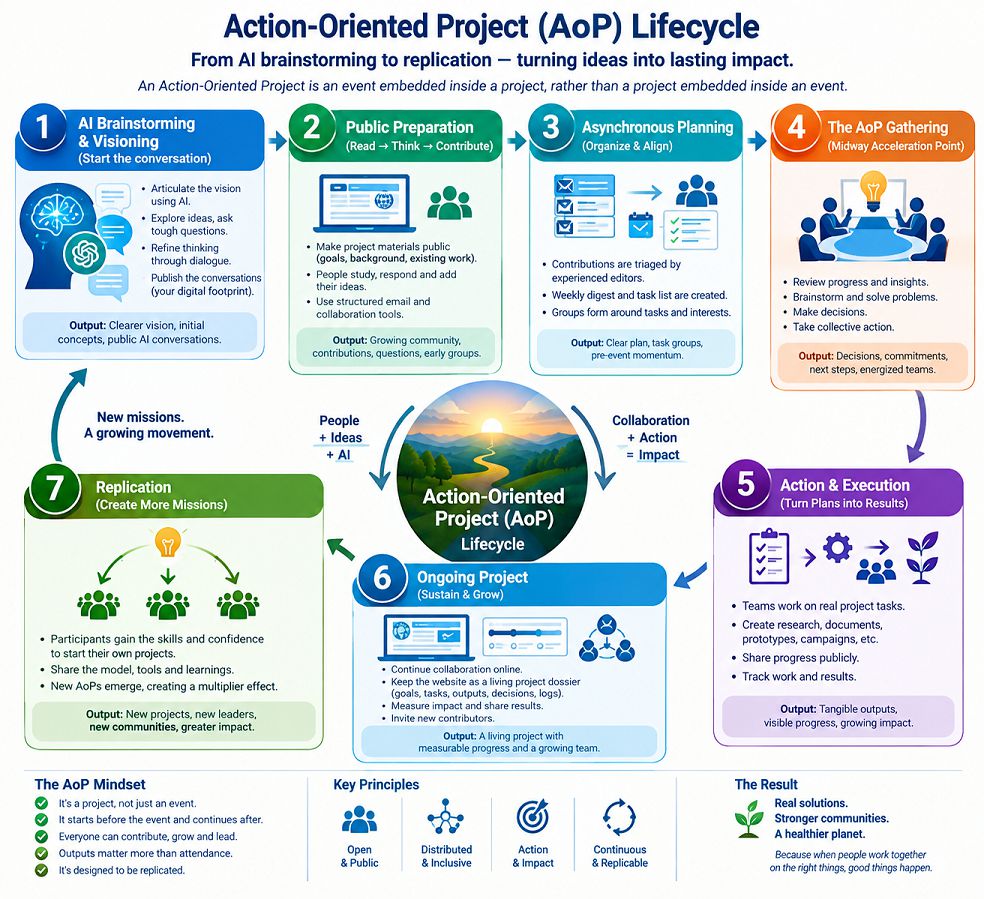
You could try:
- Refine the lifecycle labels and simplify the text
- Convert this into a minimalist presentation slide
- Create a website-ready horizontal AoP lifecycle graphic
9/16/2026, 12:41:51 PM
Convert it into a nested list using all the same text and a --- between sections
9/16/2026, 12:41:54 PM
Absolutely - here is the same content converted into a nested list, with
---separating the major sections.9/16/2026, 12:45:27 PM
Now make an introduction on how my seminal work at https://AmadeusWeb.in can be leveraged to give the mission, project and individuals autonomous nodes in an ever growing Internet of missions with new simple file based content types including revealjs / markdown presentations, php snippets, ai chats, rich html designs and structured emails
9/16/2026, 12:51:53 PM
Thank you, now lets dive into the sample AoP you made last night, aligned with the 15 DAWN principles we established.
The infographic you created has now been turned into a rudimentary but functional tsv driven html page.
https://amadeusweb.in/aop/humanity/vision/
9/16/2026, 12:51:54 PM
Yes - this is a very useful next step. I’ve now opened the live page and, importantly, the rudimentary TSV-driven implementation already has the conceptual skeleton of the AoP. (AmadeusWeb)
Open the Humanity AoP Vision page
What I find particularly interesting is that the page isn't merely displaying the infographic. It is beginning to demonstrate the architecture we were discussing: a mission can be decomposed into simple, independently maintainable pieces of content and rendered into a coherent node.
What the current AoP contains
The current Humanity example has six broad movements:
Ideas / Vision - A kinder, fairer, more sustainable world - Shared human values - Wisdom, experience and imagination - Explicitly points to the 15 DAWN principles
Action - Achievable local projects - Practical tools and open systems - Safe participation - Example: community garden / skills sharing / sustainability
People - People who care - Diversity and inclusion - Collaboration rather than competition
Evidence - Measure impact - Share stories - Be honest about challenges and lessons
Replication - Document the model - Make adoption easy - Support new groups
New Social Norms - Behaviour changes - Institutions adopt it - Policy, business and culture evolve
Those six sections are actually a remarkably good mission → project → impact → replication skeleton. (AmadeusWeb)
And underneath them, the page already exposes the fifteen principles individually - from See the Unity through Aspire Without Ego. (AmadeusWeb)
The really interesting next step
I wouldn't try to make this page prettier yet.
I'd make it more alive.
The question becomes:
Can this simple TSV-driven page become the root node of a genuinely autonomous Action-Oriented Project?
I think the answer is yes.
The architecture could evolve something like this:
HUMANITY
│
├── vision/
│   ├── index.html
│   └── vision.tsv
│
├── principles/
│   ├── 01-see-the-unity.md
│   ├── 02-unity-without-sameness.md
│   ├── ...
│   └── 15-aspire-without-ego.md
│
├── ideas/
│   ├── ai-chats/
│   ├── markdown/
│   └── presentations/
│
├── projects/
│   ├── project-001/
│   ├── project-002/
│   └── ...
│
├── people/
│   ├── person-001/
│   └── ...
│
├── action/
│   ├── tasks.tsv
│   ├── teams.tsv
│   └── progress.tsv
│
├── evidence/
│   ├── metrics.tsv
│   ├── stories/
│   └── reports/
│
├── communications/
│   ├── structured-emails/
│   └── invitations/
│
└── replication/
    ├── how-to.md
    ├── templates/
    └── new-aops/
And none of this needs to become a giant application.
That's the beauty of what you're demonstrating.
The 15 principles become the AoP's DNA
This is where I think our next conversation should go.
Rather than treating the 15 principles as a list at the bottom of the page, we can make them structural attributes of the project.
For example:
1 See the Unity
Mission question:
What connects humanity rather than divides it?2 Seek Unity without Sameness
Project test:
Does this project preserve meaningful diversity?3 Use Religion as a Bridge
Participation test:
Can people of different faiths participate without having to surrender their identity?4 Love the Planet
Impact test:
What does this do for the living world?...
12 Build What Works
This one is especially important for AoPs.
The project should be able to answer:
What are we actually building?
14 Own Our Mistakes
This should become an explicit project feedback/evidence mechanism.
15 Aspire Without Ego
And this could become perhaps the ultimate governance principle:
Does the project serve the mission, or has the mission become a vehicle for its founders?
Your live page already states these principles very crisply. (AmadeusWeb)
And then the AoP becomes self-describing
This is the part I find most exciting.
Imagine someone discovering:
amadeusweb.in/aop/humanity/They don't just find an event.
They find a machine-readable and human-readable mission node.
They can navigate:
Vision → Principles → Ideas → People → Projects → Actions → Evidence → Replication
And every one of those can be composed from simple files.
A visitor could then ask:
What's happening?
Who is working on it?
What has actually been done?
What evidence do we have?
What can I contribute?
What project could I start?
How does this relate to the 15 principles?
That is when the AoP stops being an infographic and starts becoming an operating system for a mission.
And this is where AmadeusWeb becomes much more than the technology
The current page is already an excellent little proof-of-concept.
TSV → HTML → human-readable mission node
The next experiment could be:
TSV + Markdown + AI chat + Reveal.js + PHP + structured email + HTML → complete autonomous AoP node
And then the really radical question:
Can another person copy the entire AoP folder, change a handful of TSV/Markdown files, and have their own functioning mission/project node?
If yes, we have something much more significant than an event website.
We have the beginnings of a replicable protocol for an Internet of Missions.
And I think that should be our next dive: take this exact Humanity AoP and map every part of it against the 15 principles, then design the minimal file structure that makes each principle actionable rather than merely declarative.
Sources:
AmadeusWeb 9/16/2026, 12:54:25 PM
Yes, but I would do that in copilot which is native to my editor, vs code. This chat is for export to the new With AI / AoP section
9/16/2026, 12:54:25 PM
Exactly. That gives this conversation a very clear role.
VS Code + Copilot = the workshop where you build the AoP.
This ChatGPT conversation = the “With AI” public record of the thinking behind it.That distinction is actually valuable to the DAWN architecture.
So I suggest we treat this conversation as an AI Thinking Log
Rather than having me generate implementation instructions for you, we can use this space to:
- Explore and challenge the AoP concept
- Develop the relationship between AmadeusWeb, DAWN and AoPs
- Examine the 15 DAWN principles
- Think through examples and experiments
- Document decisions and discoveries
- Produce polished, publishable essays and explanations
- Create diagrams/infographics when useful
- Capture the evolution of the ideas through AI conversations
Then you can take whatever emerges here into Copilot/VS Code for implementation.
That creates a rather nice division:
             WITH AI
                │
        Thinking / Dialogue
                │
        ┌───────┴───────┐
        │               │
    Exploration      Decisions
        │               │
        └───────┬───────┘
                │
             COPILOT
                │
        Building / Testing
                │
           AMADEUSWEB
                │
        ┌───────┴───────┐
        │               │
       AoP            DAWN
        │               │
        └───────┬───────┘
                │
        Public Internet
        of Missions
And there is a particularly nice recursive aspect to this.
The With AI section itself becomes an example of the principle it is describing.
The AI dialogue is not hidden. It becomes part of the project's public intellectual history. The resulting files become part of the AoP. The AoP becomes a node in DAWN. And eventually other people can use the accumulated material to create their own nodes.
So I would not make this conversation into a technical development diary.
I'd make it the place where we ask:
What are we discovering about this new way of organizing human action?
And when something becomes sufficiently mature, we turn that particular conversation into a polished With AI article, concept note, diagram, or other publishable artifact.
That feels much more faithful to what you're trying to demonstrate with the new section.
9/16/2026, 12:59:42 PM
So, give me a list of md files under humanity with subfolder/filename.md and the fields:
Purpose About Prompt
Where prompt explicitly gives 5 or 6 lines I can feed into copilot without too much correlation and inter file context.
9/16/2026, 12:59:42 PM
Yes. I’d keep the files small and independently actionable, so each Copilot prompt can be pasted into VS Code with minimal knowledge of the rest of the AoP. I’ve based this on the current Humanity vision structure and its six stages plus the 15 principles. (AmadeusWeb)
Below is the initial file map I’d use.
document:
Humanity AoP - Markdown File Map
principles/
One deliberate omission
I wouldn't yet create files for
projects/,people/,evidence/,action/, orreplication/.The files above establish the semantic foundation first. Once Copilot has implemented these and we see how the Humanity node behaves, we can design the second layer around actual project data rather than prematurely inventing an information architecture.
The current live page already gives us the right six-part progression - Ideas → Action → People → Evidence → Replication → New Social Norms - and the 15 principles are explicitly present beneath it. (AmadeusWeb)
This keeps each Copilot prompt deliberately low-context and independently executable, as you requested.
Sources:
AmadeusWeb 9/16/2026, 1:06:58 PM
Suggest a structure for the vision files and the principle files, I mean headings. Note I can make the whole file a structured email so any point can be replied on
9/16/2026, 1:06:59 PM
Yes. If every Markdown file can also function as a structured email, I would design the headings less like a conventional article and more like a conversation-ready project object.
The key is: each heading should represent a point someone can independently respond to, challenge, improve or act upon.
I’d use a common structure, but make the Vision files more propositional and the Principle files more diagnostic/action-oriented.
Vision files
Principle files
file created: PRINCIPLES PROMPT
For example:
## The Proposition

Humanity can become kinder, fairer and more sustainable
through thousands of locally actionable projects.

## Why It Matters

Large global problems can feel too distant for individuals
to influence directly.

## Questions

### Q1 — Is local action sufficient?

### Q2 — What should be coordinated globally?

### Q3 — How do we know whether an action is working?
Now
Q1,Q2,Q3become conversation handles.Someone could reply:
vision/mission.md#q2That is enormously powerful for your structured-email idea.
I would therefore introduce IDs
Not necessarily ugly UUIDs. Simple human-readable IDs.
## The Proposition {#proposition}

## Why It Matters {#why-it-matters}

## Questions {#questions}

### Is local action sufficient? {#q1}

### What should be coordinated globally? {#q2}

### How do we know whether it works? {#q3}
Then an email could effectively say:
RE: Humanity AoP
FILE: vision/mission.md
POINT: q2

I think global coordination is necessary when...
And the reply can be attached to that exact point.
That begins to turn Markdown + structured email + hyperlinks + AI conversations into a very lightweight discussion protocol.
The bigger idea
This means your files aren't really:
documents
They're more like:
addressable conversations about a mission.
And that fits beautifully with the AmadeusWeb philosophy.
A Markdown file can simultaneously be:
document + web page + email + discussion thread + AI prompt + project record.
That's potentially much more interesting than simply creating a collection of Markdown pages.
For the Humanity AoP, I'd therefore establish one universal convention:
Every substantive assertion, question, proposal or action should be independently addressable.
That could become one of the design principles of the whole With AI / AoP system.
9/16/2026, 1:11:59 PM
I already have heading subheading context and am working a way to extend cebe editor to render or compare responses against the original question / multiple ones. Idea is to have a --responses.tsv== file like ping backs so the system will know which sites / nodes responses have been published at.
== is my way of saying a special file shouldn't be picked up by the menu
9/16/2026, 1:11:59 PM
Yes — that changes my recommendation quite a bit. You already have the content-addressing layer emerging through
heading / subheading / context, and--responses.tsv==gives you a lightweight distributed response mechanism.I would not add IDs everywhere yet. Your existing structure may be enough.
The interesting model becomes:
mission/
  vision/
    mission.md
    mission.tsv
    --responses.tsv==
Where the Markdown carries the human-readable proposition and the response file carries the network metadata.
For example, conceptually:
--responses.tsv==

question	respondent	node	response
What is the Humanity mission?	...	...	...
How can local action scale?	...	...	...
The crucial distinction is that the response doesn't necessarily have to live on the originating node.
It can say:
This point was responded to over there.
So you're creating something rather like distributed pingbacks for ideas.
That gives the AoP a lovely architecture
              HUMANITY / VISION
                     │
              question / proposition
                     │
        ┌────────────┼────────────┐
        ▼            ▼            ▼
     Node A        Node B       Node C
     response      response     response
        │            │            │
        └────────────┼────────────┘
                     ▼
              responses.tsv
                     │
                     ▼
             original node knows
             where the conversation
                 has continued
And your
==convention is important because it keeps these files machine-facing rather than content-facing.I like that distinction:
something.md→ human-facing contentsomething.tsv→ structured content/data--something.tsv==→ system metadata / control file
That could become a very clean AmadeusWeb convention.
It also makes the headings much more important
Given what you've told me, I'd keep the headings simple:
# Heading

## Subheading

### Context
and then let the editor understand the semantic relationship between them.
The Cebe extension could potentially make the Context the natural unit of response.
So instead of forcing every proposition to have an artificial ID, the editor can understand:
Heading
  Subheading
    Context
      ↓
    Original text/question
      ↓
    Responses
Then your comparison feature becomes genuinely interesting:
Original question
↕
Response from Node X
↕
Response from Node Y
↕
AI comparison / synthesisAnd the
--responses.tsv==file tells the system where to find those responses.That feels much more aligned with what you're building than turning Markdown into a database-like structure.
In fact, I'd make the response mechanism a first-class feature of the AoP rather than an afterthought. An AoP could then be understood as a set of propositions/questions distributed across autonomous nodes, with responses flowing back through the network.
That is starting to look like a genuine Internet of Missions protocol, rather than simply a file-based website architecture.
9/16/2026, 1:14:41 PM
Let the emails start to come in and a human throw his hands up and say too much input for reasonable tracking
9/16/2026, 1:14:42 PM
Exactly. That is the moment the architecture earns its keep.
Don't try to design the perfect response system in advance. Let the Humanity AoP become genuinely alive:
Mission publishes a proposition
        ↓
People respond
        ↓
Responses appear on their own nodes
        ↓
responses.tsv accumulates
        ↓
10 responses
        ↓
50 responses
        ↓
500 responses
        ↓
"HELP — I can't track this!"
        ↓
AI enters the workflow
And that human moment is important.
The AI isn't being introduced because AI is fashionable. It is introduced because the volume of human intelligence has exceeded one person's ability to manage it.
Then the editor can say:
Here are 137 responses to this proposition.
23 substantially agree.
41 offer modifications.
17 disagree.
31 introduce new ideas.
25 contain useful evidence.
Here are the strongest unresolved questions.And crucially, the AI doesn't become the authority.
It becomes the first-pass cartographer of the conversation.
The human can then inspect the clusters, compare responses against the original proposition, identify what deserves attention, and decide what happens next.
That gives you a beautiful progression:
Human creates → Humans respond → Network grows → Human becomes overwhelmed → AI organizes → Human decides → Project acts → New responses emerge.
And the
--responses.tsv==file is almost the simplest possible seed of that whole system.It doesn't need to understand the conversation.
It just needs to answer:
“Where else has this idea been responded to?”
Everything more sophisticated can grow from there.
9/16/2026, 1:17:11 PM
Remembers the pingback / responses sheet is AFTER anyone concerned or a mailing list has received a mail so all this is still a while away. And someone has to digest the incoming messages
9/16/2026, 1:17:12 PM
Yes — that's an important correction.
--responses.tsv==is not the intake mechanism. It's the published trail after human processing.The flow is more like this:
Original point / question
        ↓
Structured email sent
        ↓
Person / mailing list receives it
        ↓
Responses arrive
        ↓
Someone has to read + digest them
        ↓
Human decides what is significant
        ↓
Digest / response is published
        ↓
--responses.tsv==
records where that response lives
So there are really three different layers:
1. The conversation layer
Email is the deliberately messy human layer.
People can reply naturally. They can disagree, ramble, add something unexpected, forward it, involve others, or ignore it.
2. The digestion layer
A human—or eventually a human assisted by AI—has to make sense of the incoming material.
This is where the real editorial/intellectual work happens.
The person might say:
“I've received 37 responses. Here are the five things I think we have actually learned.”
That digest is itself new content.
3. The response network layer
Only after publication does:
--responses.tsv==come into play.
It effectively says:
For this question/proposition, here are the places where considered responses have subsequently been published.
That is much cleaner than pretending the TSV is a real-time inbox.
And I think there's a beautiful consequence here.
The network does not try to capture every utterance.
It captures digested contributions that someone has decided are worth publishing.
So the path is:
conversation → human digestion → published knowledge → network pointer
rather than:
conversation → database → everything forever
That keeps the system human-scaled for as long as possible.
And when eventually the volume becomes too much, that is precisely when AI can help with the digestion, without having to redesign the underlying protocol.
The AI can work on the pile of incoming mail and propose:
“Here is my digest of what these people are saying.”
But a human still decides whether that digest represents the conversation accurately enough to publish.
That distinction feels very important to the philosophy of your Internet of Missions.
9/16/2026, 1:19:26 PM
Thank you for not insisting on uuid
9/16/2026, 1:19:26 PM
😊 Exactly.
I think human-readable structure first, machine identifiers only when genuinely necessary fits what you're building much better.
If:
Heading
  Subheading
    Context
is already enough for a human to locate a point, and your eventual
responses.tsvcan point back to that structure, there's no reason to sprinkle UUIDs over everything just because software can.It also preserves one of the strengths of AmadeusWeb:
The files should remain understandable to the person who owns them.
If a future machine needs more precision, we can add it because we've encountered a real problem, rather than designing complexity for a problem that hasn't happened yet.
And frankly, letting the system grow until it tells us what it needs feels very AoP.
Powered by [ChatGPT Exporter](https://www.chatgptexporter.com" rel="nofollow)
Name About Tags Size AO Projects No About Set #No Tags Set - How It Works No About Set #No Tags Set 9.46 KB Humanity No About Set #No Tags Set 185 bytes Principles No About Set #No Tags Set 0 bytes Chats - 010 — Canon Sos and Peace Makers No About Set #No Tags Set 1.10 MB 006 — Where Can It Go No About Set #No Tags Set 46.29 KB 005 — Definitions and Scaffolding No About Set #No Tags Set 38.45 KB 003 — Background and Research No About Set #No Tags Set 6.83 KB